

Before Francisco Goya became known for his harrowing depictions of war and madness, he spent many years as a celebrated painter of refinement and intellect. His early career reflects a close alignment with the values of the Enlightenment, a period that prized reason, progress, and human dignity. Working his way from modest beginnings into the royal court, Goya earned admiration for his skill and perceptive eye. This phase of his work speaks to a world still confident in order and civility, before that confidence unraveled in the face of political turmoil and personal suffering.
The royal court and the language of flattery
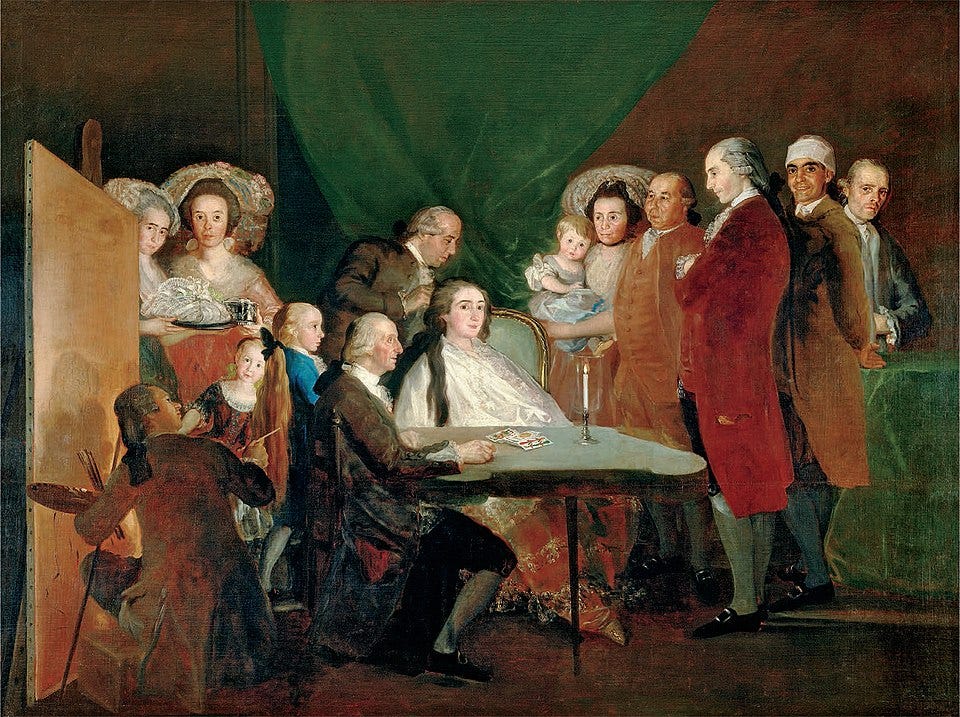
Goya’s rise to prominence was shaped by his role as a court painter, where he was expected to portray members of the aristocracy in a flattering light. Yet even in these formal commissions, he managed to suggest a spectrum of personality and social nuance. One early example is The Family of the Infante Don Luis, painted in 1783. The group sits in a relaxed domestic setting, surrounded by artists and servants. Light pools gently across the canvas, softening the scene. Each figure appears absorbed in their own thoughts or activities, creating a sense of individual presence rather than rigid hierarchy. The inclusion of Goya himself blurs the line between the nobility and those who serve them.
The Enlightenment and the individual
Goya brought the Enlightenment to life through intimate, psychologically rich portrayals of its leading minds. His 1798 portrait of Gaspar Melchor de Jovellanos, a reform-minded minister and philosopher, is filled with contemplation. Jovellanos sits alone at his desk, eyes distant, as if a thought has just possessed him. Shadows envelop the background, isolating the figure and pushing his thoughtful expression into focus.
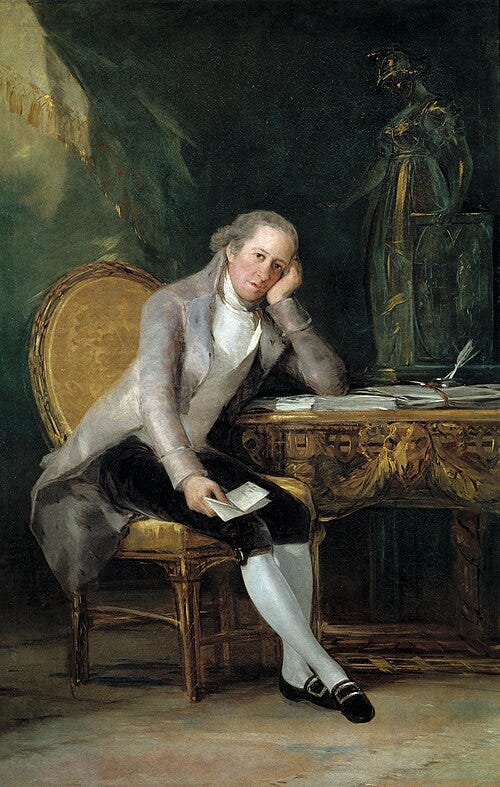
The setting is not opulent but reserved, emphasizing intellect over material riches and a statue of Minerva, goddess of wisdom, glows faintly in the dim light. This reminds us of the silent ideals guiding the scene.
Charm with a critical edge
While Goya produced many refined and luminous paintings during this period, he was never merely an ornament of the court. Beneath the elegance ran a subtle current of critique. In The Fair at Madrid, a crowd of aristocrats gather beneath the open sky, looking on to a merchant in the shadows. At first glance, it is a celebration of Spanish life and its glamorous culture. However as the eye lingers, one begins to notice the frictions, including the visual contrast between classes created by light and the subtle exaggerations of posture suggesting an act.

Goya’s wit and clarity of vision gave him the power to render otherwise pleasant scenes with a touch of irony and unease. His early works flatter, but they also hint that beneath the laughter and sunlight, something more complex is at play: a power struggle disguised as a performance of civility.
A sign of the transformation to come
Goya’s early period is rich in psychological insight, veiled beneath a superficial adherence to the expectations of royal portraiture. He always found ways to infuse his work with depth and subtle critique.
As Spain descended into war, repression, and upheaval, the tone of Goya’s art would shift. The façade would fracture and give way to chaos. In these earlier paintings, the more abrasive, complex, and confrontational spirit can already be felt. The darkness that later consumed his vision was already gathering, waiting for history to call it to the fore.