

In a large room at the Spanish court, you see a young princess standing at the center. Her ladies-in-waiting lean toward her. Further back, a courtier pauses in a sunlit doorway, and to the side, a painter stands beside a towering canvas.
Meanwhile, on the back wall, a mirror reflects the faint images of King Philip IV and Queen Mariana. Their reflection is opposite you…
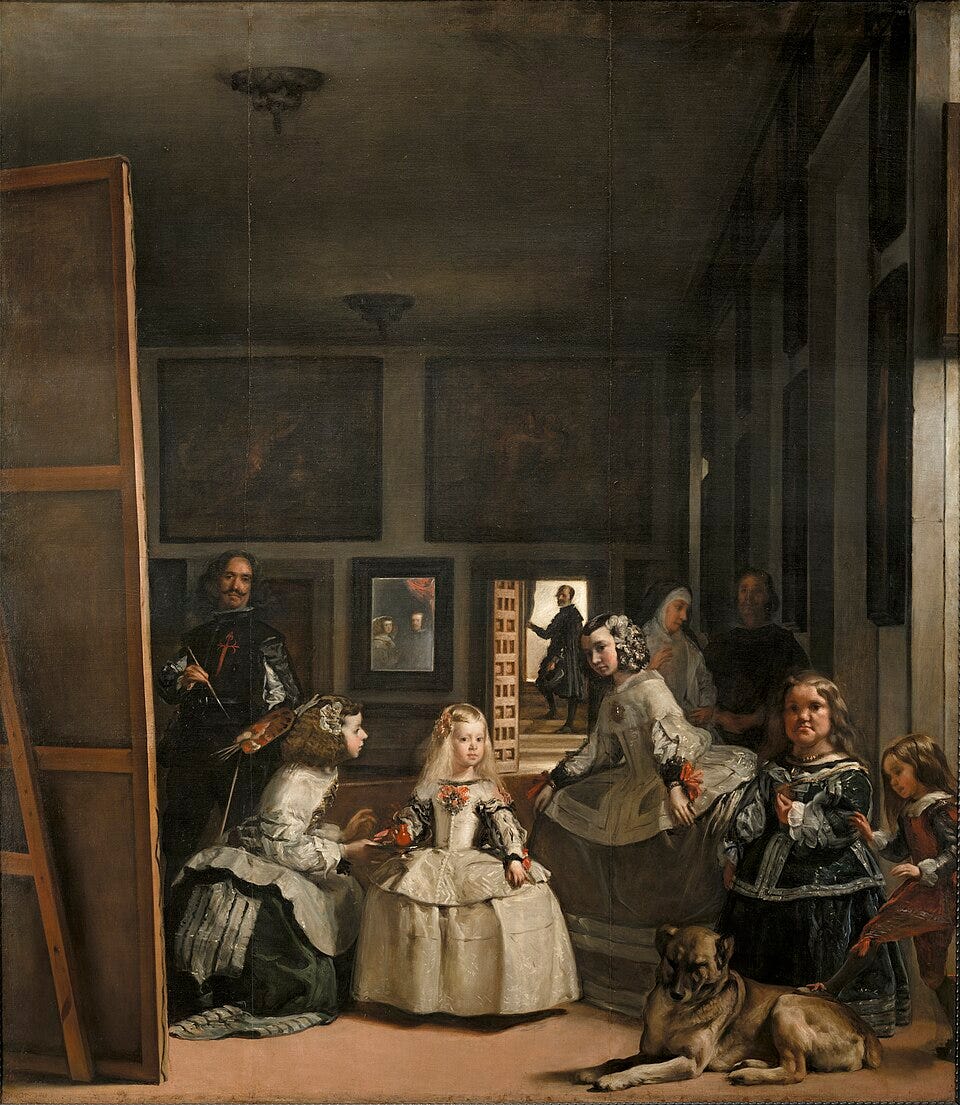
Las Meninas, painted by Diego Velázquez in 1656, appears at first to be only a royal family portrait. But the longer you look, the more uncertain it becomes. The viewpoint is strangely central, and the painter’s eyes seem to pierce through the frame. Velázquez constructs not just a static scene, but an immersive experience that draws you in.
From observation to intimacy
Velázquez had already earned a reputation for quiet realism before he became court painter to King Philip IV. His early works, such as The Water Seller of Seville, gave ordinary figures the weight and dignity usually reserved for saints.
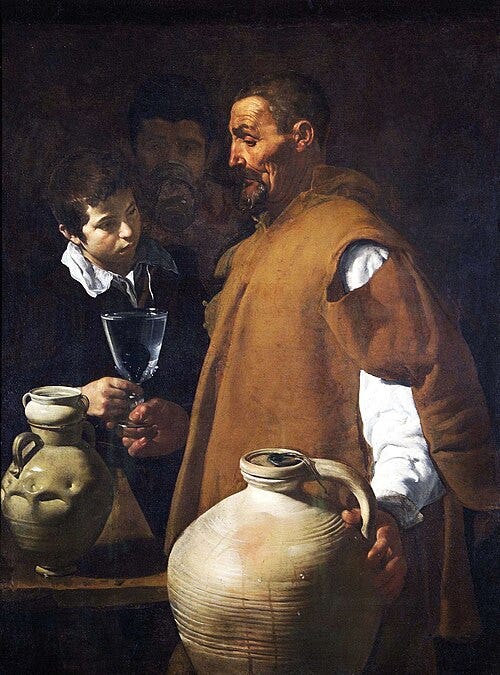
This respect for everyday life remained constant, even as Velázquez’s subjects changed. At court, he painted kings, jesters, and dwarfs with the same human expressions. Monarchs appear solemn, self-contained, and quietly burdened. Velázquez captured not only appearances, but the invisible threads of power and relations that shaped the person beneath.
A portrait that breaks its own frame
In Las Meninas, the conventions of portraiture are unraveled. Though the Infanta Margarita stands at the center, the painting refuses to let her take over the scene. Each figure is absorbed in another point of interest, encouraging the viewer to follow their gaze.
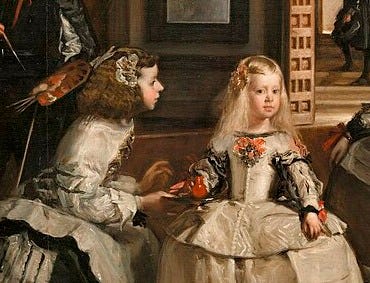
Eventually, through the mirror or the painter’s stare, the viewer finds themselves positioned beyond the image, outside of the frame. The viewpoint begins to overlap with that of the king and queen, forcing a shift in perspective. But this offers no final resting point. It simply restarts the cycle. Meaning emerges not from any single figure, but from the dynamic play of attention.

Foucault and the disappearance of the subject
In The Order of Things (1966), French philosopher and historian Michel Foucault opened with a close reading of Las Meninas. He argued that the painting marked a shift in how images represent reality. In earlier periods, representation was anchored in a stable structure: the subject was clearly depicted, the viewer stood physically outside the image, and the focal point was always located within the scene. Las Meninas, he believed, exposed the limits of that structure and how easily it could be fractured.
Rather than positioning the viewer as an external observer, the painting implicates them within the scene. What appeared to be a portrait became, in Foucault’s view, a reflection on the conditions that make portraiture possible. The relationships between artist, subject, and viewer no longer followed a linear path. Instead, they formed a loop in which each element depended on the others for definition.
Foucault noted that the monarchs were not directly depicted, but emerged through inferences and shifting points of view. He saw this structure as a turning point in Western thought, where representation no longer guaranteed definite knowledge.
The dignity of ambiguity
Velázquez offers no final resolution. By veiling the subject and placing the monarchs outside the visible frame, he takes control of the composition. In this act, the painting invites inquiry. Las Meninas does not explain; it withholds. It offers no fixed meaning, only the conditions for reflection. Power, perception, and identity are not located in what is directly shown, but in the shifting relations and implications of the scene.