

You stare into a valley in flames. Two cities, once proud and glittering in the desert night, are now consumed by fire pouring from the heavens. The sky is alive with wrath, roiling in deep reds and golds. Below, buildings buckle and disintegrate. Rivers of fire rush through streets that no longer exist. In the foreground, a few survivors flee, hunched over and tired. Even in escape, there is only despair.
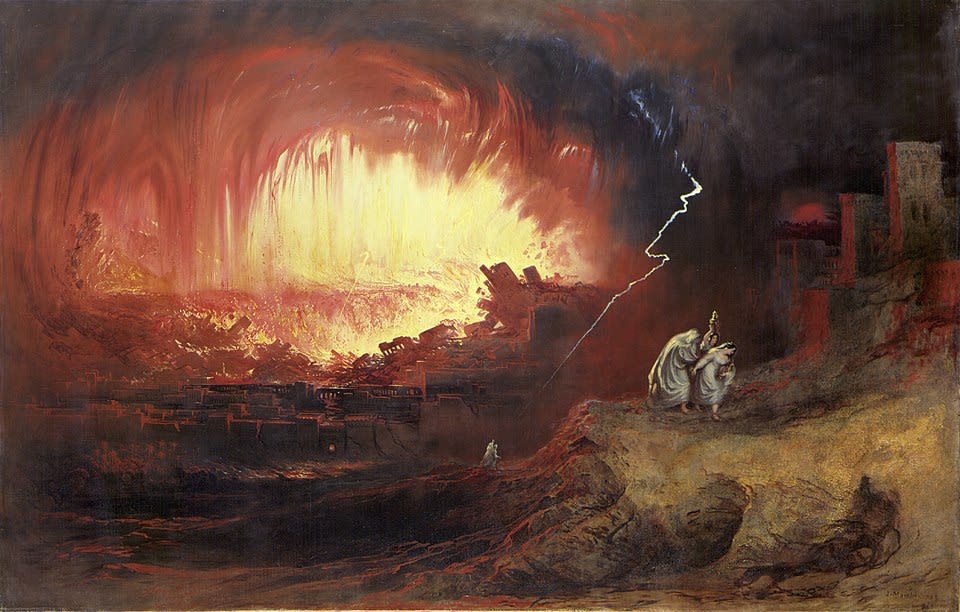
Born in 1789 in Northumberland, Martin rose from obscurity to become one of the most widely exhibited painters of his age. Martin belonged to the Romantic movement, but his vision was uniquely apocalyptic. Where other painters sought solitude in nature, Martin conjured the end of cities, of civilizations, of time itself. His canvases channel the sublime not through introspection and tranquillity, but through immense spectacle. At the heart of each piece is a question. What happens when humanity meets the infinite?
Divine Wrath Translated Through Nature
Few works embody the cataclysm of final judgment as fully as The Great Day of His Wrath. Mountains shear away from their foundations. The sky churns with fire and ash, as an unstoppable force descending upon the world. People are dragged into the abyss, with nothing left to hold onto.
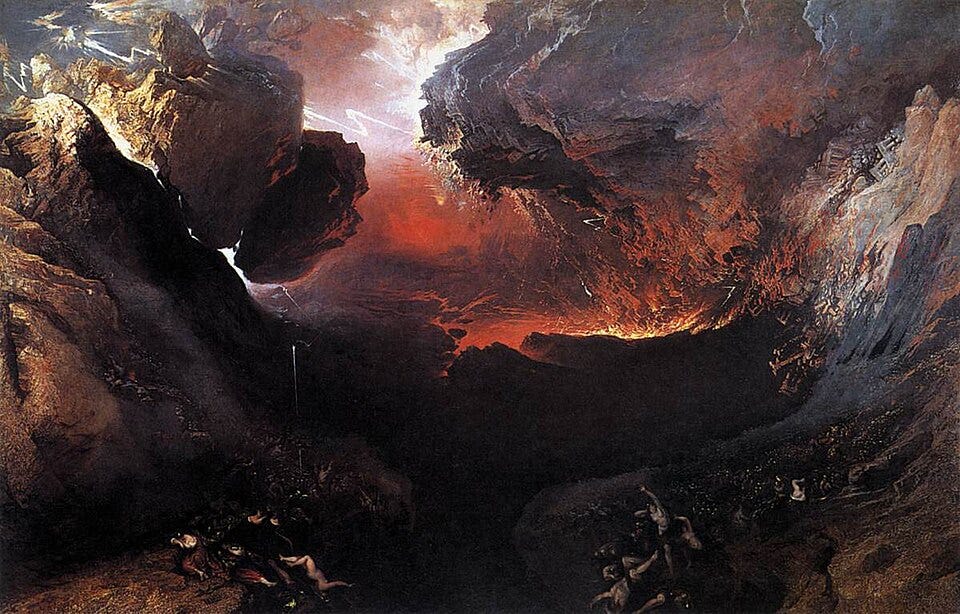
Here, Martin renders the biblical apocalypse not as distant allegory, but as immediate and overwhelming reality. His command of light and scale does not simply depict destruction, but immerses the viewer within it. For Martin, the apocalypse is not a private vision or symbolic tale. It is a shared, inescapable reckoning.
The Fragility of Empire
In The Fall of Babylon (1831), Martin shifts to a scene with both divine and human conflict. A sprawling cityscape stretches wide, with Hanging Gardens, soaring walls and towering bridges. It is under siege. In the foreground, Belshazzar is betrayed and murdered in a palace intrigue, even as all around him armies clash and walls collapse under the weight of divine retribution. The sky above is pierced by lightning, a supernatural signal that doom is at hand and a judgment has been made.
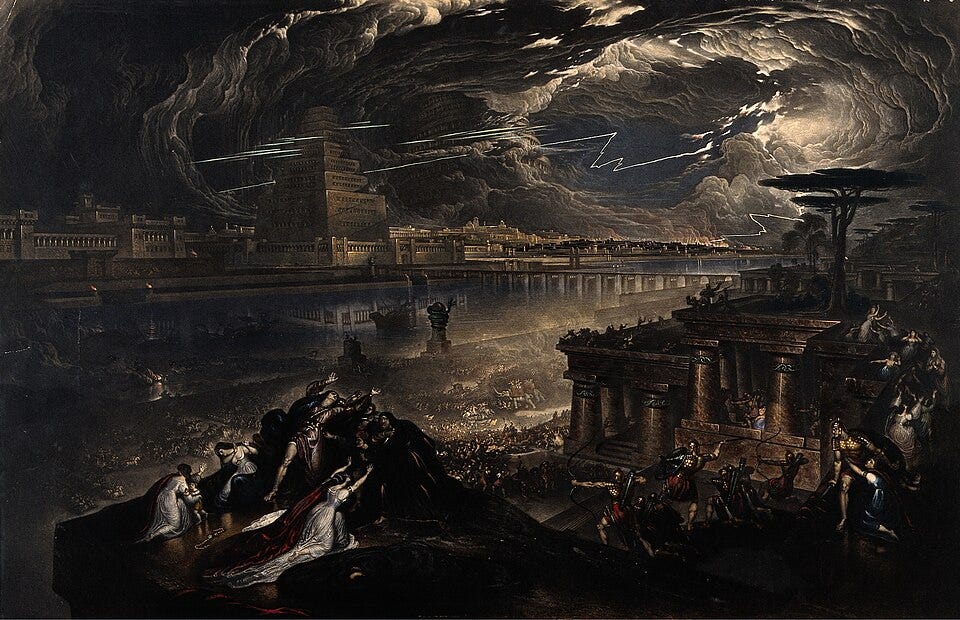
This vision reveals Martin’s layered interpretation of antiquity and faith. His Babylon is not simply destroyed by time, but attacked from within and without. Nature aligns itself with the act of vengeance, reinforcing biblical prophecy and Romantic drama. Martin invites us to see downfall not as slow erosion, but as a sudden and violent event.
A Vision of Moral Reckoning
In The Seventh Plague of Egypt, Martin relies on atmosphere and gesture to convey impending catastrophe. A vast city unfolds across the canvas, its architecture a fusion of Egyptian monumentality and imagined antiquity. Overhead, heavy clouds begin to part, revealing a narrow shaft of ominous light that casts the stone structures in a pale, uneasy glow. Along the lower edge of the scene, small figures cower and shrink away, their postures tense with fear. The tension is palpable.
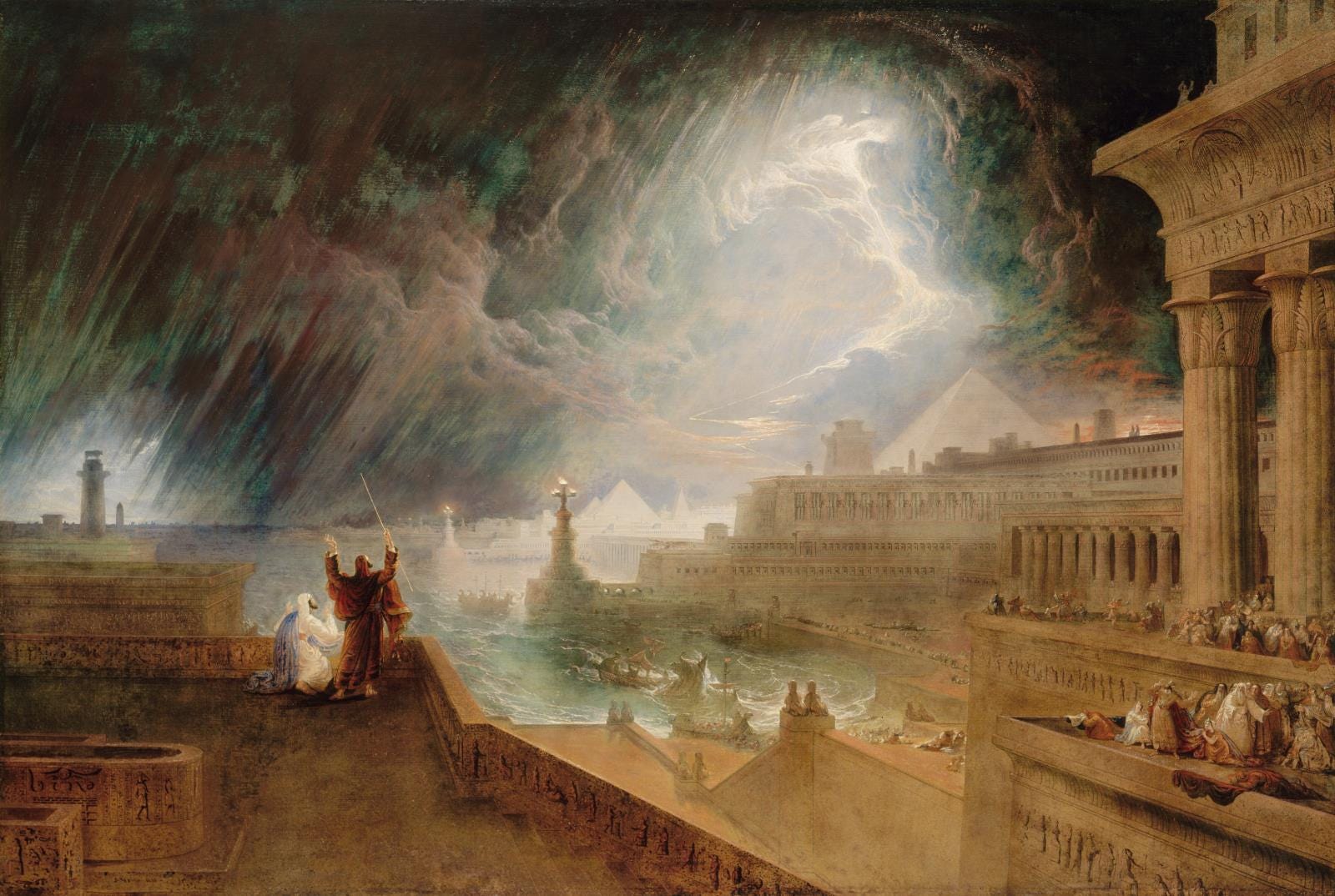
Unlike his more catastrophic depictions, this scene is more reserved. The drama lies not in what is explicitly shown, but in what is about to unfold.
A Horror Frozen in Time
Belshazzar’s Feast (1820) presents a sprawling banquet scene set within a colossal palace, framed by ornate columns and vaulted ceilings. The hall is densely populated with figures in ceremonial clothing, frozen mid-reaction as a glowing inscription appears on the far wall. King Belshazzar recoils in shock while Daniel, cloaked in black, gestures toward the divine message. Behind them, monumental architecture extends into the distance, incorporating imagined elements of ancient Babylon, including the Hanging Gardens and Tower of Babel.
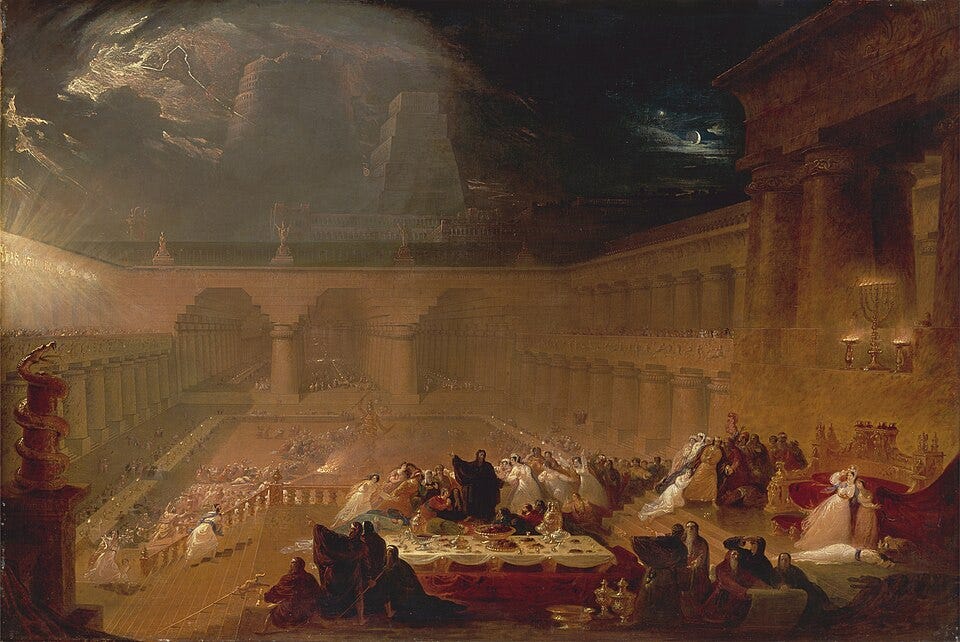
This painting exemplifies Martin’s broader artistic ambition: to stage moments of biblical reckoning on a grand, theatrical scale. Like many of his apocalyptic works, it combines historical drama with architectural fantasy to convey the fragile boundary between human glory and divine power. Though less overtly destructive than his later visions of judgment, Belshazzar’s Feast shares the same structural tension. People are overwhelmed by forces beyond their comprehension, framed within cities too large and lavish to endure.
Seeing Beyond the Destruction
John Martin did not paint the end of the world simply to frighten or astonish. He painted it to reveal the limits of human power, the impermanence of empire, and the mystery that lies beyond comprehension. His apocalypses are not just scenes of collapse, but meditations on time, morality, and divine presence. Each canvas suggests that beneath every monument, a fault line waits. That every expression of pride or glory contains the seeds of its own destruction.